
The DMs were there.
The opportunities weren't.
This case study showcases how I approached a complex, cross-functional redesign of the Manychat Inbox. Leading discovery, shaping the UX strategy, and driving alignment across product, engineering, and leadership to deliver three AI-powered features and an 8% Pro retention lift.
Ask anything
9:41


For you
by ai
Chat
Don’t miss a thing!
9
Hot Lead

12
Waiting for you

6
Collab request

2
Needs an answer

1
Needs attention

Comments for you
3
Questions

Home

Inbox

Contacts

Automations
9:41


FOR YOU
BY AI
Chat
Handled today
12M Avg response


126 comments
4 corrections
2 took over
DMs
5
Booked calls
3
Follow-ups sent
9
Sales started
+12%
than last week
Posts AI replied to
3 hours saved

126
Comments handled

AI knowledge
What I couldn't answer
Refund policy for group coaching

Add
Availability for Q2 workshops
Add
What I know
Pricing guide
Refund policy

Home

Inbox

Contacts

Automations
9:41


FOR YOU
BY AI
Chat

All DMs
240

Interested
12

Engaged
4

Urgent
0

Lucas Brown
2 h
Thrilled to start learning. What's the registration process?
Input needed
FAQ


Martín
2 h
Please, you have to help me
AI handled
Issue

Emily Johnson
2 h
Excited to jump into the course. Where do I start?
Reply ready
FAQ


Jamie Kowalski
3 h
Keen on exploring this course. What's the sign-up process?
Input needed
Lead

Emily Wong
4 h
Eager to get started. What are the next steps?
Reply ready
Lead

Sophia Martinez
1 d
Ready to level up my skills. How do I register?
Follow up
Lead

Martín
2 d
Please, you have to help me
Held for you
Sensitive

Home

Inbox

Contacts

Automations
01 . CONTEXT
Good design starts before the first sketch
My role
Sole designer — owning discovery, UX strategy, stakeholder alignment, and UI execution across all three shipped features.
Team
Product Director
Product Manager
FE Lead
Back end
4 engineers
About Manychat
Manychat is a conversational marketing platform with 1M+ active businesses across Instagram, WhatsApp, and Messenger. The Inbox is the core of the product — where creators and sellers manage every customer interaction in real time.

02 . The Challenge
Not all conversations are equal.
business problem
15% of high-value Pro sellers were cancelling — a segment driving ~60% of ARR. The Inbox was the reason.
User problem
The inbox is a flat list. Every message looks the same. Creators decide what matters by instinct, every time.
⭐
Turn the Inbox from a communication tool into a revenue tool. Then let AI run it.
03 . Process overview
Alignment is a design problem too.
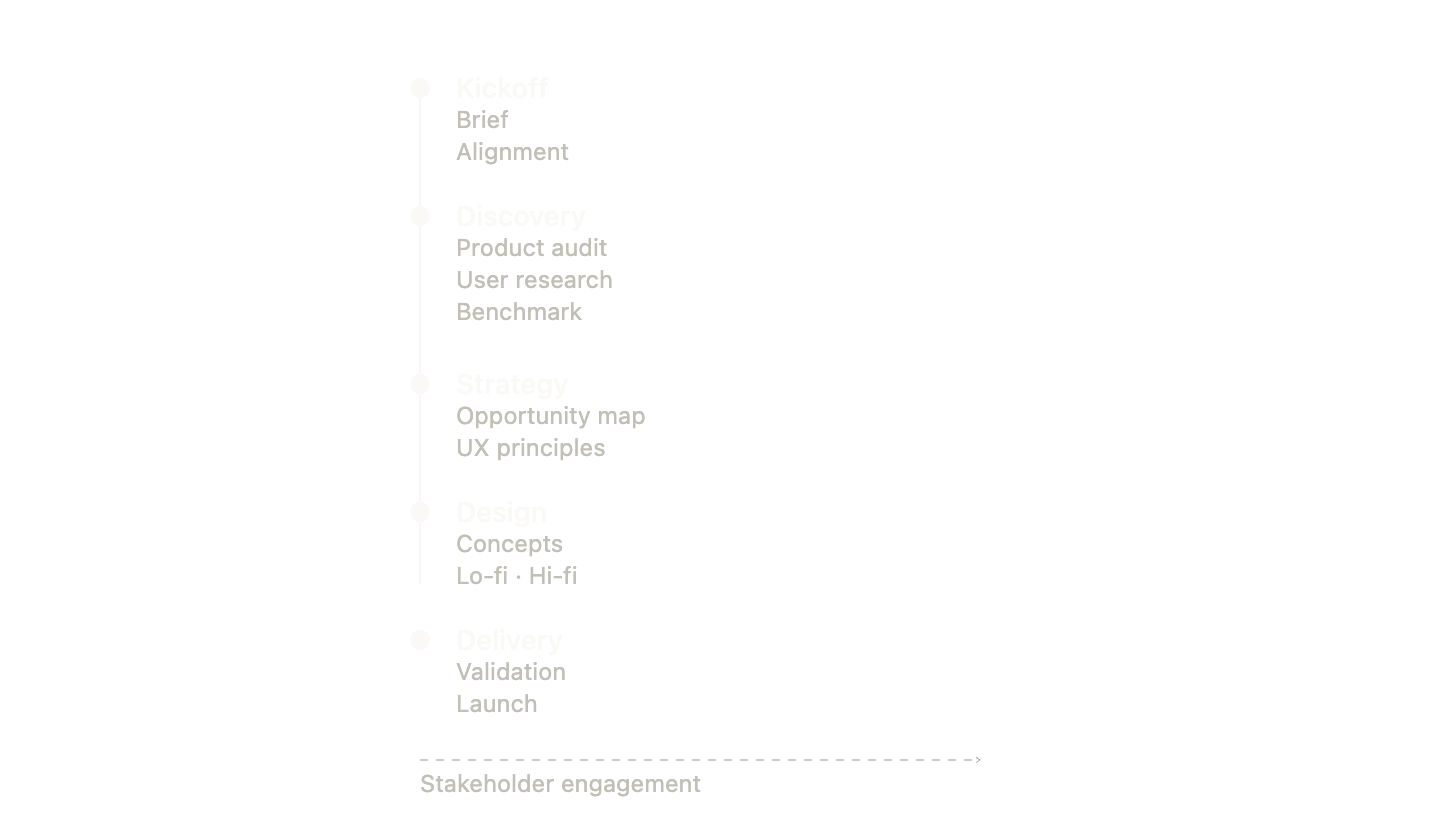
At Manychat, I was the lead designer on Inbox end-to-end. I defined the problem framing after reanalysing existing data, ran 8 moderated user interviews across creators, SMBs and local businesses, and set the design principles that shaped every decision. I presented the vision to leadership, aligned the PM and engineering leads around a phased approach, and the work became a company-wide north star for AI adoption.
04 . Discovery
Good research is never a solo sport
Before touching a single frame, I ran a collaborative discovery sprint with cross-functional stakeholders (Product, Engineering, Marketing, Support and Data) — mapping the competitive landscape, analysing inbox usage data, and speaking directly with the creators losing business in the noise."
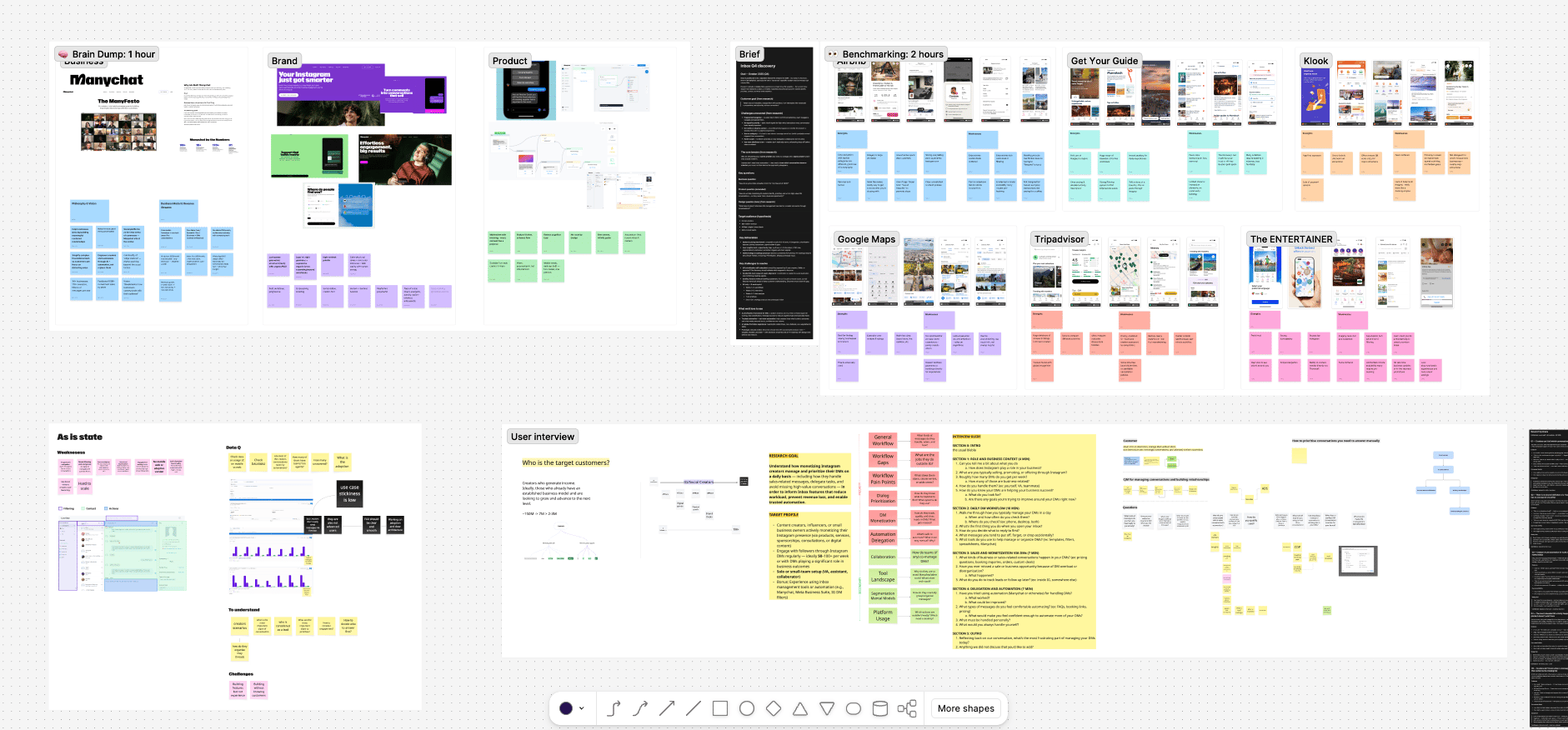
Collaborative workshop — Product audit · Benchmark · Data analysis
User research
8 moderated interviews with monetising IG creators — the same four pain points kept coming up, unprompted:

I get like 150 DMs a day. I just scroll and try to spot the ones that look important... I definitely miss stuff.

I know a good conversation when I see it. But I don't have a system — it's all in my head.

I use automations for the easy questions. But anything that could be a sale, I handle myself. I'm too scared the bot messes it up.
No priority signal Every DM looks the same. Creators scroll and guess.
No concept of a lead Creators know a lead when they see one. The product doesn't.
Automation anxiety If it could be a sale, they handle it manually. Every time.
Mobile blind spot Creators live on their phones. The inbox doesn't exist there.
Opportunity map
From the research patterns, four opportunity areas emerged — each one mapped to a product direction.
Help creators find, prioritise and act on the conversations that drive their business
Surface the signal
Inbox categorisation
Lead identification
Speed without compromise
Draft with reasoning
Reply ready signal
Inbox as intelligence
Chat-based insights
Hot leads view
Revenue tracking
05 . UX strategy
Design for the 30 seconds that matter
From spotting a high-value conversation to sending a reply — with AI doing the heavy lifting, and the creator staying in control.
Signal over noise
The right conversation should be findable in seconds.
Clarity over completeness
Show what matters. Don't show everything.
Frictionless action
From spotting a high-value conversation to sending a reply.
06 . The system
Built to Scale Across Every Surface
One inbox. Three views. Everything a user needs to stay on top of every conversation that matters.
Ask anything
9:41
For you
by ai
Chat
Don’t miss a thing!
9
Hot Lead
12
Waiting for you
6
Collab request
2
Needs an answer
1
Needs attention
Comments for you
3
Questions
Home
Inbox
Contacts
Automations
- For you
Know exactly where to start. No digging, no guessing.
9:41
FOR YOU
BY AI
Chat
Handled today
12M Avg response


126 comments
4 corrections
2 took over
DMs
5
Booked calls
3
Follow-ups sent
9
Sales started
+12%
than last week
Posts AI replied to
3 hours saved
126
Comments handled

AI knowledge
What I couldn't answer
Refund policy for group coaching

Add
Availability for Q2 workshops
Add
What I know
Pricing guide
Refund policy
Home
Inbox
Contacts
Automations
- By AI
See what AI handled while you were away — and where it still needs you.
9:41
FOR YOU
BY AI
Chat
All DMs
240
Interested
12
Engaged
4
Urgent
0
Lucas Brown
2 h
Thrilled to start learning. What's the registration process?
Input needed
FAQ
Martín
2 h
Please, you have to help me
AI handled
Issue
Emily Johnson
2 h
Excited to jump into the course. Where do I start?
Reply ready
FAQ
Jamie Kowalski
3 h
Keen on exploring this course. What's the sign-up process?
Input needed
Lead
Emily Wong
4 h
Eager to get started. What are the next steps?
Reply ready
Lead
Sophia Martinez
1 d
Ready to level up my skills. How do I register?
Follow up
Lead
Martín
2 d
Please, you have to help me
Held for you
Sensitive
Home
Inbox
Contacts
Automations
- CHAT
Every DM you open is worth opening.
Categorisation
The right conversations surface on their own — no behaviour change required. A score that reads the room so sellers don't have to.
Emily Johnson
2 h
Excited to jump into the course. Where do I start?
Reply ready
FAQ
Martín
2 h
Please, you have to help me
AI handled
Issue
Sophia Martinez
1 d
Ready to level up my skills. How do I register?
Follow up
Lead
Jamie Kowalski
3 h
Keen on exploring this course. What's the sign-up process?
Input needed
Lead
Ask me anything · Management
One question to your inbox. Any answer you need. Hot leads, business performance, follow-ups, knowledge gaps — all surfaced without opening a single DM.
Ask anything about your business. The AI searches every DM so you don't have to.
Hot leads is one query. The same interface works for business stats, follow-ups, and knowledge gaps.
Action - Reply support
Speed without losing voice. AI drafts the reply, seller stays in control. The suggestion does the heavy lifting — the sender still owns the message.
9:41


Michael Lee
Interested in your 12-week course

Today 8:10 AM
Hi, I just started a new job. I'm looking for a medium-size fashionable blouse.
Hey Savannah! Thank you so much for this message. Would you like me to keep you informed about my new programs?

Hey Savannah! Thank you so much for this message. Would you like me to keep you informed about my new programs?

I saw that course, and I’d love to take it. What shoudl I do?
It's never too late — 2 years tells me you're serious. Want to see what week 1 looks like?

Reply...


Draft an answer


Summarize conversation

Write my thoughts

9:41
Michael Lee
Interested
Today 8:10 AM
Hey! I keep starting fitness things and never finishing. Saw your post about the Reboot — is it actually different?
Automation
Hey Michael! So glad you reached out. Tell me a bit more — what's been getting in the way?

I work from home, basically no routine. Tried the gym but always quit after a week.
Agent auto-reply
That's exactly who the Reboot is built for. Want to see what week 1 looks like?

Yes! How much is it and when does it start?

Drafting your reply

9:41
Michael Lee
Interested
Today 8:10 AM
Hey! I keep starting fitness things and never finishing. Saw your post about the Reboot — is it actually different?
Automation
Hey Michael! So glad you reached out. Tell me a bit more — what's been getting in the way?
I work from home, basically no routine. Tried the gym but always quit after a week.
Agent auto-reply
That's exactly who the Reboot is built for. Want to see what week 1 looks like?
Yes! How much is it and when does it start?
Reply ready
|
Why
I went with validation first, no pitch. Similar to how you replied to @sarah.wellness when she had doubts. You tend to lead with encouragement before sharing details.
Sources
It's never too late. 2 years of trying tells me you're serious about change. The 12-Week Reboot is built for people exactly where you are. Want to see what week 1 looks like?
Should I send this?
Edit
Send
07 . Closing
What got measured, and what we learned.
8%
Pro retention lift
74%
Smart Folders adoption on day one
~22%
faster time to first high-intent interaction
↑
Inbox elevated to company-wide OKR
What I learned
Alignment is harder than design. The most important decision I made, it was the stakeholder workshop that got everyone looking at the same problem.
AI features need to earn trust before they can deliver value. Automation anxiety was real.


The DMs were there.
The opportunities weren't.
This case study showcases how I approached a complex, cross-functional redesign of the Manychat Inbox. Leading discovery, shaping the UX strategy, and driving alignment across product, engineering, and leadership to deliver three AI-powered features and an 8% Pro retention lift.
Ask anything
9:41


For you
by ai
Chat
Don’t miss a thing!
9
Hot Lead

12
Waiting for you

6
Collab request

2
Needs an answer

1
Needs attention

Comments for you
3
Questions
Home
Inbox
Contacts
Automations
9:41
FOR YOU
BY AI
Chat
Handled today
12M Avg response


126 comments
4 corrections
2 took over
DMs
5
Booked calls
3
Follow-ups sent
9
Sales started
+12%
than last week
Posts AI replied to
3 hours saved
126
Comments handled

AI knowledge
What I couldn't answer
Refund policy for group coaching

Add
Availability for Q2 workshops
Add
What I know
Pricing guide
Refund policy

Home

Inbox

Contacts

Automations
9:41


FOR YOU
BY AI
Chat

All DMs
240

Interested
12

Engaged
4

Urgent
0
Lucas Brown
2 h
Thrilled to start learning. What's the registration process?
Input needed
FAQ

Martín
2 h
Please, you have to help me
AI handled
Issue
Emily Johnson
2 h
Excited to jump into the course. Where do I start?
Reply ready
FAQ

Jamie Kowalski
3 h
Keen on exploring this course. What's the sign-up process?
Input needed
Lead
Emily Wong
4 h
Eager to get started. What are the next steps?
Reply ready
Lead
Sophia Martinez
1 d
Ready to level up my skills. How do I register?
Follow up
Lead
Martín
2 d
Please, you have to help me
Held for you
Sensitive
Home
Inbox
Contacts
Automations
01 . CONTEXT
Good design starts before the first sketch
My role
Sole designer — owning discovery, UX strategy, stakeholder alignment, and UI execution across all three shipped features.
Team
Product Manager
FE Lead
Back end
4 engineers
Product Director
About Manychat
Manychat is a conversational marketing platform with 1M+ active businesses across Instagram, WhatsApp, and Messenger. The Inbox is the core of the product — where creators and sellers manage every customer interaction in real time.

02 . The Challenge
Not all conversations are equal.
business problem
15% of high-value Pro sellers were cancelling — a segment driving ~60% of ARR. The Inbox was the reason.
User problem
The inbox is a flat list. Every message looks the same. Creators decide what matters by instinct, every time.
⭐
Turn the Inbox from a communication tool into a revenue tool. Then let AI run it.
03 . Process overview
Alignment is a design problem too.
At Manychat, I was the lead designer on Inbox end-to-end. I defined the problem framing after reanalysing existing data, ran 8 moderated user interviews across creators, SMBs and local businesses, and set the design principles that shaped every decision. I presented the vision to leadership, aligned the PM and engineering leads around a phased approach, and the work became a company-wide north star for AI adoption.

04 . Discovery
Good research is never a solo sport
Before touching a single frame, I ran a collaborative discovery sprint with cross-functional stakeholders (Product, Engineering, Marketing, Support and Data) — mapping the competitive landscape, analysing inbox usage data, and speaking directly with the creators losing business in the noise."
Collaborative workshop — Product audit · Benchmark · Data analysis
User research
8 moderated interviews with monetising IG creators — the same four pain points kept coming up, unprompted:
I get like 150 DMs a day. I just scroll and try to spot the ones that look important... I definitely miss stuff.
I know a good conversation when I see it. But I don't have a system — it's all in my head.
I use automations for the easy questions. But anything that could be a sale, I handle myself. I'm too scared the bot messes it up.
No priority signal Every DM looks the same. Creators scroll and guess.
No concept of a lead Creators know a lead when they see one. The product doesn't.
Automation anxiety If it could be a sale, they handle it manually. Every time.
Mobile blind spot Creators live on their phones. The inbox doesn't exist there.
Opportunity map
From the research patterns, four opportunity areas emerged — each one mapped to a product direction.
Help creators find, prioritise and act on the conversations that drive their business
Surface the signal
Inbox categorisation
Lead identification
Speed without compromise
Draft with reasoning
Reply ready signal
Inbox as intelligence
Chat-based insights
Hot leads view
Revenue tracking
05 . UX strategy
Design for the 30 seconds that matter
From spotting a high-value conversation to sending a reply — with AI doing the heavy lifting, and the creator staying in control.
Signal over noise
The right conversation should be findable in seconds.
Clarity over completeness
Show what matters. Don't show everything.
Frictionless action
From spotting a high-value conversation to sending a reply.
06 . The system
Built to Scale Across Every Surface
One inbox. Three views. Everything a user needs to stay on top of every conversation that matters.
Ask anything
9:41
For you
by ai
Chat
Don’t miss a thing!
9
Hot Lead
12
Waiting for you
6
Collab request
2
Needs an answer
1
Needs attention
Comments for you
3
Questions
Home
Inbox
Contacts
Automations
- For you
Know exactly where to start. No digging, no guessing.
9:41
FOR YOU
BY AI
Chat
Handled today
12M Avg response
126 comments
4 corrections
2 took over
DMs
5
Booked calls
3
Follow-ups sent
9
Sales started
+12%
than last week
Posts AI replied to
3 hours saved
126
Comments handled
AI knowledge
What I couldn't answer
Refund policy for group coaching
Add
Availability for Q2 workshops
Add
What I know
Pricing guide
Refund policy
Home
Inbox
Contacts
Automations
- By AI
See what AI handled while you were away — and where it still needs you.
9:41
FOR YOU
BY AI
Chat
All DMs
240
Interested
12
Engaged
4
Urgent
0
Lucas Brown
2 h
Thrilled to start learning. What's the registration process?
Input needed
FAQ
Martín
2 h
Please, you have to help me
AI handled
Issue
Emily Johnson
2 h
Excited to jump into the course. Where do I start?
Reply ready
FAQ
Jamie Kowalski
3 h
Keen on exploring this course. What's the sign-up process?
Input needed
Lead
Emily Wong
4 h
Eager to get started. What are the next steps?
Reply ready
Lead
Sophia Martinez
1 d
Ready to level up my skills. How do I register?
Follow up
Lead
Martín
2 d
Please, you have to help me
Held for you
Sensitive
Home
Inbox
Contacts
Automations
- CHAT
Every DM you open is worth opening.
Categorisation
The right conversations surface on their own — no behaviour change required. A score that reads the room so sellers don't have to.
Emily Johnson
2 h
Excited to jump into the course. Where do I start?
Reply ready
FAQ
Martín
2 h
Please, you have to help me
AI handled
Issue
Sophia Martinez
1 d
Ready to level up my skills. How do I register?
Follow up
Lead
Jamie Kowalski
3 h
Keen on exploring this course. What's the sign-up process?
Input needed
Lead
Ask me anything · Management
One question to your inbox. Any answer you need. Hot leads, business performance, follow-ups, knowledge gaps — all surfaced without opening a single DM.
Ask anything about your business. The AI searches every DM so you don't have to.
Hot leads is one query. The same interface works for business stats, follow-ups, and knowledge gaps.
Action - Reply support
Speed without losing voice. AI drafts the reply, seller stays in control. The suggestion does the heavy lifting — the sender still owns the message.
9:41


Michael Lee
Interested in your 12-week course

Today 8:10 AM
Hi, I just started a new job. I'm looking for a medium-size fashionable blouse.
Hey Savannah! Thank you so much for this message. Would you like me to keep you informed about my new programs?

Hey Savannah! Thank you so much for this message. Would you like me to keep you informed about my new programs?

I saw that course, and I’d love to take it. What shoudl I do?
It's never too late — 2 years tells me you're serious. Want to see what week 1 looks like?
Reply...


Draft an answer


Summarize conversation

Write my thoughts

9:41
Michael Lee
Interested
Today 8:10 AM
Hey! I keep starting fitness things and never finishing. Saw your post about the Reboot — is it actually different?
Automation
Hey Michael! So glad you reached out. Tell me a bit more — what's been getting in the way?

I work from home, basically no routine. Tried the gym but always quit after a week.
Agent auto-reply
That's exactly who the Reboot is built for. Want to see what week 1 looks like?

Yes! How much is it and when does it start?

Drafting your reply

9:41
Michael Lee
Interested
Today 8:10 AM
Hey! I keep starting fitness things and never finishing. Saw your post about the Reboot — is it actually different?
Automation
Hey Michael! So glad you reached out. Tell me a bit more — what's been getting in the way?
I work from home, basically no routine. Tried the gym but always quit after a week.
Agent auto-reply
That's exactly who the Reboot is built for. Want to see what week 1 looks like?
Yes! How much is it and when does it start?
Reply ready
|
Why
I went with validation first, no pitch. Similar to how you replied to @sarah.wellness when she had doubts. You tend to lead with encouragement before sharing details.
Sources
It's never too late. 2 years of trying tells me you're serious about change. The 12-Week Reboot is built for people exactly where you are. Want to see what week 1 looks like?
Should I send this?
Edit
Send
07 . Closing
What got measured, and what we learned.
8%
Pro retention lift
74%
Smart Folders adoption on day one
~22%
faster time to first high-intent interaction
↑
Inbox elevated to company-wide OKR
What I learned
Alignment is harder than design. The most important decision I made, it was the stakeholder workshop that got everyone looking at the same problem.
AI features need to earn trust before they can deliver value. Automation anxiety was real.

The DMs were there.
The opportunities weren't.
This case study showcases how I approached a complex, cross-functional redesign of the Manychat Inbox. Leading discovery, shaping the UX strategy, and driving alignment across product, engineering, and leadership to deliver three AI-powered features and an 8% Pro retention lift.
Ask anything
9:41

For you
by ai
Chat
Don’t miss a thing!
9
Hot Lead
12
Waiting for you
6
Collab request
2
Needs an answer
1
Needs attention
Comments for you
3
Questions
Home
Inbox
Contacts
Automations
9:41
FOR YOU
BY AI
Chat
Handled today
12M Avg response
126 comments
4 corrections
2 took over
DMs
5
Booked calls
3
Follow-ups sent
9
Sales started
+12%
than last week
Posts AI replied to
3 hours saved
126
Comments handled
AI knowledge
What I couldn't answer
Refund policy for group coaching
Add
Availability for Q2 workshops
Add
What I know
Pricing guide
Refund policy
Home
Inbox
Contacts
Automations
9:41
FOR YOU
BY AI
Chat
All DMs
240
Interested
12
Engaged
4
Urgent
0
Lucas Brown
2 h
Thrilled to start learning. What's the registration process?
Input needed
FAQ
Martín
2 h
Please, you have to help me
AI handled
Issue
Emily Johnson
2 h
Excited to jump into the course. Where do I start?
Reply ready
FAQ
Jamie Kowalski
3 h
Keen on exploring this course. What's the sign-up process?
Input needed
Lead
Emily Wong
4 h
Eager to get started. What are the next steps?
Reply ready
Lead
Sophia Martinez
1 d
Ready to level up my skills. How do I register?
Follow up
Lead
Martín
2 d
Please, you have to help me
Held for you
Sensitive
Home
Inbox
Contacts
Automations
01 . CONTEXT
Good design starts before the first sketch
My role
Sole designer — owning discovery, UX strategy, stakeholder alignment, and UI execution across all three shipped features.
Team
Product Director
Product Manager
FE Lead
Back end
4 engineers
About Manychat
Manychat is a conversational marketing platform with 1M+ active businesses across Instagram, WhatsApp, and Messenger. The Inbox is the core of the product — where creators and sellers manage every customer interaction in real time.

02 . The Challenge
Not all conversations are equal.
business problem
15% of high-value Pro sellers were cancelling — a segment driving ~60% of ARR. The Inbox was the reason.
User problem
The inbox is a flat list. Every message looks the same. Creators decide what matters by instinct, every time.
⭐
Turn the Inbox from a communication tool into a revenue tool. Then let AI run it.
03 . Process overview
Alignment is a design problem too.
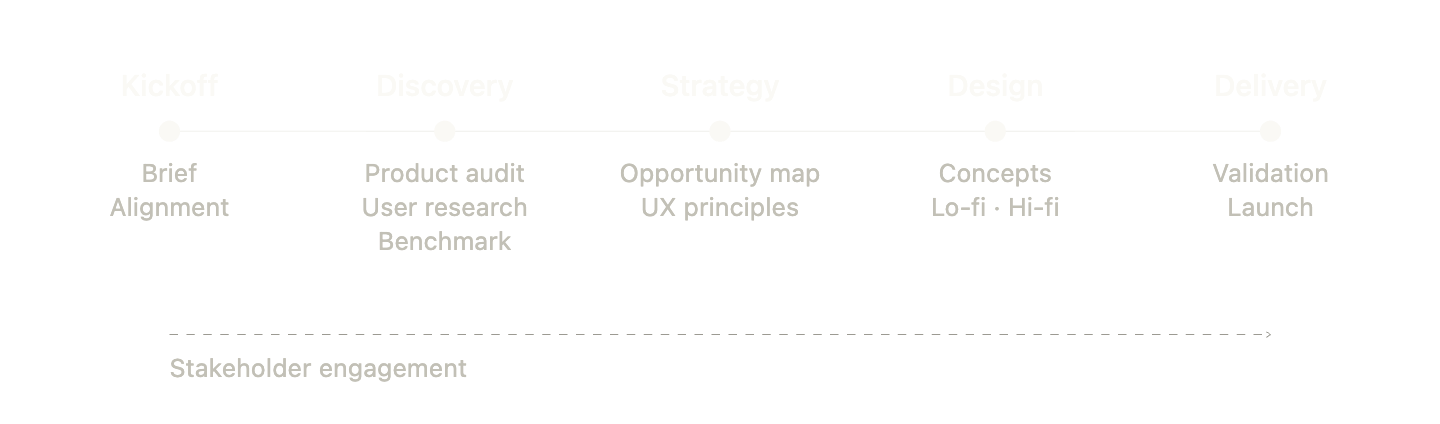
Before any design work began, I facilitated a cross-functional alignment session to reframe the brief — moving the team from a UX optimisation mindset to a retention problem. From there, the project followed a structured discovery process with stakeholder engagement running throughout every phase.
04 . Discovery
Good research is never a solo sport
Before touching a single frame, I ran a collaborative discovery sprint with cross-functional stakeholders (Product, Engineering, Marketing, Support and Data) — mapping the competitive landscape, analyzing inbox usage data, and speaking directly with the creators losing business in the noise.
Collaborative workshop — Product audit · Benchmark · Data analysis
User research
8 moderated interviews with monetising IG creators — the same four pain points kept coming up, unprompted:
I get like 150 DMs a day. I just scroll and try to spot the ones that look important... I definitely miss stuff.
I know a good conversation when I see it. But I don't have a system — it's all in my head.
I use automations for the easy questions. But anything that could be a sale, I handle myself. I'm too scared the bot messes it up.
No priority signal Every DM looks the same. Creators scroll and guess.
No concept of a lead Creators know a lead when they see one. The product doesn't.
Automation anxiety If it could be a sale, they handle it manually. Every time.
Mobile blind spot Creators live on their phones. The inbox doesn't exist there.
Opportunity map
From the research patterns, four opportunity areas emerged — each one mapped to a product direction.
Help creators find, prioritise and act on the conversations that drive their business
Surface the signal
Inbox categorisation
Lead identification
Speed without compromise
Draft with reasoning
Reply ready signal
Inbox as intelligence
Chat-based insights
Hot leads view
Revenue tracking
05 . UX strategy
Design for the 30 seconds that matter
From spotting a high-value conversation to sending a reply — with AI doing the heavy lifting, and the creator staying in control.
Signal over noise
The right conversation should be findable in seconds.
Clarity over completeness
Show what matters. Don't show everything.
Frictionless action
From spotting a high-value conversation to sending a reply.
06 . The system
Built to Scale Across Every Surface
One inbox. Three views. Everything a user needs to stay on top of every conversation that matters.
Ask anything
9:41
For you
by ai
Chat
Don’t miss a thing!
9
Hot Lead
12
Waiting for you
6
Collab request
2
Needs an answer
1
Needs attention
Comments for you
3
Questions
Home
Inbox
Contacts
Automations
- For you
Know exactly where to start. No digging, no guessing.
9:41
FOR YOU
BY AI
Chat
Handled today
12M Avg response
126 comments
4 corrections
2 took over
DMs
5
Booked calls
3
Follow-ups sent
9
Sales started
+12%
than last week
Posts AI replied to
3 hours saved
126
Comments handled
AI knowledge
What I couldn't answer
Refund policy for group coaching
Add
Availability for Q2 workshops
Add
What I know
Pricing guide
Refund policy
Home
Inbox
Contacts
Automations
- By AI
See what AI handled while you were away — and where it still needs you.
9:41
FOR YOU
BY AI
Chat
All DMs
240
Interested
12
Engaged
4
Urgent
0
Lucas Brown
2 h
Thrilled to start learning. What's the registration process?
Input needed
FAQ
Martín
2 h
Please, you have to help me
AI handled
Issue
Emily Johnson
2 h
Excited to jump into the course. Where do I start?
Reply ready
FAQ
Jamie Kowalski
3 h
Keen on exploring this course. What's the sign-up process?
Input needed
Lead
Emily Wong
4 h
Eager to get started. What are the next steps?
Reply ready
Lead
Sophia Martinez
1 d
Ready to level up my skills. How do I register?
Follow up
Lead
Martín
2 d
Please, you have to help me
Held for you
Sensitive
Home
Inbox
Contacts
Automations
- CHAT
Every DM you open is worth opening.
Categorization
The right conversations surface on their own — no behaviour change required. A score that reads the room so sellers don't have to.
Emily Johnson
2 h
Excited to jump into the course. Where do I start?
Reply ready
FAQ
Martín
2 h
Please, you have to help me
AI handled
Issue
Sophia Martinez
1 d
Ready to level up my skills. How do I register?
Follow up
Lead
Jamie Kowalski
3 h
Keen on exploring this course. What's the sign-up process?
Input needed
Lead
Ask me anything · Management
One question to your inbox. Any answer you need. Hot leads, business performance, follow-ups, knowledge gaps — all surfaced without opening a single DM.
Ask anything about your business. The AI searches every DM so you don't have to.
Hot leads is one query. The same interface works for business stats, follow-ups, and knowledge gaps.
Action - Reply support
Speed without losing voice. AI drafts the reply, seller stays in control. The suggestion does the heavy lifting — the sender still owns the message.
9:41

Michael Lee
Interested in your 12-week course
Today 8:10 AM
Hi, I just started a new job. I'm looking for a medium-size fashionable blouse.
Hey Savannah! Thank you so much for this message. Would you like me to keep you informed about my new programs?
Hey Savannah! Thank you so much for this message. Would you like me to keep you informed about my new programs?
I saw that course, and I’d love to take it. What shoudl I do?
It's never too late — 2 years tells me you're serious. Want to see what week 1 looks like?
Reply...

Draft an answer
Summarize conversation
Write my thoughts
9:41
Michael Lee
Interested
Today 8:10 AM
Hey! I keep starting fitness things and never finishing. Saw your post about the Reboot — is it actually different?
Automation
Hey Michael! So glad you reached out. Tell me a bit more — what's been getting in the way?
I work from home, basically no routine. Tried the gym but always quit after a week.
Agent auto-reply
That's exactly who the Reboot is built for. Want to see what week 1 looks like?
Yes! How much is it and when does it start?
Drafting your reply
9:41
Michael Lee
Interested
Today 8:10 AM
Hey! I keep starting fitness things and never finishing. Saw your post about the Reboot — is it actually different?
Automation
Hey Michael! So glad you reached out. Tell me a bit more — what's been getting in the way?
I work from home, basically no routine. Tried the gym but always quit after a week.
Agent auto-reply
That's exactly who the Reboot is built for. Want to see what week 1 looks like?
Yes! How much is it and when does it start?
Reply ready
|
Why
I went with validation first, no pitch. Similar to how you replied to @sarah.wellness when she had doubts. You tend to lead with encouragement before sharing details.
Sources
It's never too late. 2 years of trying tells me you're serious about change. The 12-Week Reboot is built for people exactly where you are. Want to see what week 1 looks like?
Should I send this?
Edit
Send
07 . Closing
What got measured, and what we learned.
8%
Pro retention lift
74%
Smart Folders adoption on day one
~22%
faster time to first high-intent interaction
↑
Inbox elevated to company-wide OKR
What I learned
Alignment is harder than design. The most important decision I made, it was the stakeholder workshop that got everyone looking at the same problem.
AI features need to earn trust before they can deliver value. Automation anxiety was real.

